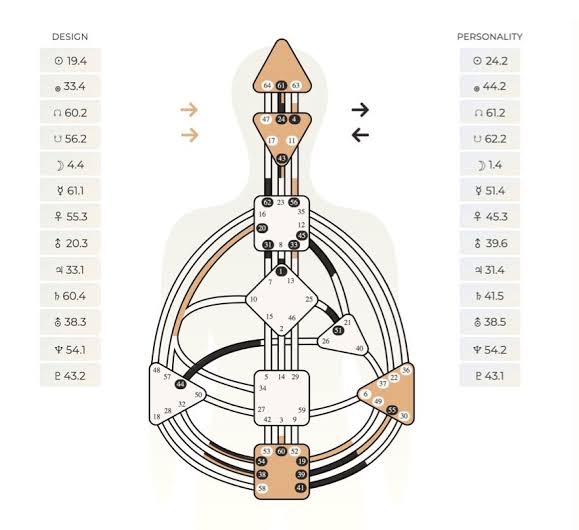
If you’ve spent any time on wellness or self-discovery corners of the internet lately, you’ve probably run into the term “Human Design Chart.” Maybe a friend sent you a colorful diagram covered in geometric shapes and numbers, or you saw a TikTok explaining why you’re a “Projector” and it somehow felt eerily accurate. Whatever brought you here, you’re not alone — Human Design has exploded from a niche spiritual system into a mainstream tool that millions of people now use to understand themselves, make decisions, and navigate their relationships and careers.
This guide is the only resource you’ll need to actually understand your Human Design Chart — not just what it looks like, but what it means and how to use it in real life. We’ll walk through the origins of the system, break down every component of your chart, explain the five energy types in depth, cover all seven inner authorities, and show you exactly how to read your own chart step by step. By the end, you’ll be able to look at your BodyGraph and understand it the way a longtime practitioner would.
What You’ll Learn
- What a Human Design Chart actually is and where the system comes from
- How your chart is calculated from your birth data
- Every major component of the BodyGraph — centers, channels, gates, profiles, and more
- The five Human Design types and how they differ
- The seven inner authorities and how to use yours to make decisions
- A step-by-step method for reading any chart, including your own
- Common mistakes beginners make
- How Human Design compares to astrology, numerology, and other systems
- Answers to the most frequently asked questions about Human Design
What Is a Human Design Chart?
A Human Design Chart, also called a BodyGraph, is a personalized diagram that maps out your energetic and psychological blueprint based on your exact birth date, time, and location. Visually, it looks like a humanoid figure made up of nine geometric shapes (called centers), connected by lines (called channels), with numbers scattered throughout (called gates).
The system was created in 1987 by a Canadian named Ra Uru Hu, who claimed the information came to him during an eight-day mystical experience in Ibiza, Spain. Whatever you make of its origin story, what followed was a synthesis of several older traditions into one unified framework — something Ra called “a science of differentiation.”
At its core, a Human Design Chart is meant to reveal:
- How you’re energetically built — where you have consistent, reliable energy and where you’re more open and impressionable
- How you’re meant to make decisions — your unique “inner authority”
- How you’re meant to interact with the world — your “type” and “strategy”
- The themes and gifts you carry — through your gates, channels, and profile
What makes Human Design unique compared to something like astrology is that it isn’t just descriptive — it’s prescriptive. It doesn’t just tell you who you are; it gives you a specific strategy for how to move through life with less resistance, built around the idea that most of us have been conditioned away from our authentic nature.
How Does a Human Design Chart Work?
Your chart is generated using three pieces of birth data:
- Birth date — the day, month, and year you were born
- Birth time — as precise as possible, since even a few minutes can shift certain gate activations
- Birth location — the city and country where you were born, used to calculate your exact position relative to the sun and planets at that moment
From there, a Human Design calculator plots two sets of planetary positions: one from the moment of your birth, and one from approximately 88 days before your birth (roughly when the sun was at the degree that corresponds to your natal sun position). These two data sets are layered onto the BodyGraph as red (unconscious/design) and black (conscious/personality) activations.
Human Design describes itself as a synthesis of several older systems:facebook.com
- Astrology — the use of planetary positions and the zodiac wheel to determine gate activations
- The I Ching — the ancient Chinese system of 64 hexagrams, which map directly onto the 64 gates of the BodyGraph
- The Chakra system — the nine centers of the BodyGraph loosely correspond to the energy centers found in yogic and Hindu traditions
- Kabbalah — the Tree of Life is said to have influenced the structural layout of the BodyGraph
- Quantum physics — Ra Uru Hu described the system as incorporating concepts of neutrinos and genetic conditioning, though this connection is symbolic and philosophical rather than scientifically established. It’s worth noting that Human Design is not recognized by the scientific community as an evidence-based system, and this framing should be understood as part of its mythology rather than a scientific claim.
The result is a chart that’s part astrology, part ancient philosophy, and part original framework — designed to give you a highly individualized map of your energy.
Components of a Human Design ChartDigital Marketing Batch 10
Once you generate your chart, you’ll see a lot of information packed into one image. Here’s what every piece means.
Energy Centers
There are nine centers on every BodyGraph, each corresponding to a different area of life and function. Centers are either defined (colored in) or undefined/open (white or outlined) depending on your birth data.
Head Center — Where mental pressure and inspiration originate. It’s the source of questions, ideas, and inspiration that get passed down to the Ajna.
Ajna Center — Associated with the mind, beliefs, and how you process and conceptualize information. This is where thoughts get formed into concepts and opinions.
Throat Center — The center of communication, manifestation, and action. Nearly all expression — whether speaking, doing, or creating — is channeled through the Throat.
G Center — Sometimes called the Identity Center. It governs your sense of self, direction, and love. It’s tied to questions of identity and life direction.
Ego/Heart Center — Also called the Will Center. This governs willpower, self-worth, ego, and material world commitments like promises and contracts.
Solar Plexus Center — The emotional center, associated with feelings, moods, and — for those with it defined — emotional waves that need time to settle before decisions are made.
Sacral Center — The center of life force energy, work capacity, and sexuality. About 70% of the population has this center defined, making Sacral-defined types (Generators and Manifesting Generators) the most common in the population.
Spleen Center — The center of intuition, instinct, and the immune system. It communicates in the present moment, often as a quiet, in-the-moment knowing.
Root Center — The center of pressure, stress, and drive. It fuels the adrenaline that pushes you into action and can also be a source of chronic pressure or urgency.
Defined vs. Undefined Centers
A defined center is one that operates consistently and reliably — this is an area where you have a fixed, dependable way of operating that doesn’t change based on who’s around you. Defined centers are considered part of your consistent energetic “signature.”
An undefined (or open) center is more fluid and receptive. These are areas where you take in and amplify the energy of others around you — which can be a gift (deep wisdom and adaptability) but also a trap, if you absorb other people’s energy as if it were your own. A huge amount of Human Design work revolves around learning to distinguish “what’s mine” from “what I’m picking up from someone else” in your open centers.
Notably, having open centers isn’t a flaw — the wisdom of Human Design is that open centers are actually where you’re designed to learn the most about life, precisely because you experience so many different variations of that energy through other people.
Channels
A channel is a connection between two centers, formed when both gates at either end of that channel are activated. There are 36 channels in total. When a channel is fully formed, it creates a defined center on each end and establishes a consistent life force theme running between the two.
Channels are named after the combination of their two gates (for example, “The Channel of Charisma,” 34-20) and each carries its own specific theme, describing a particular way that energy is expressed between the two centers it connects.
Gates
Gates are the 64 individual points around the BodyGraph, each corresponding to one of the 64 hexagrams of the I Ching. Each gate represents a specific theme, archetype, or life force — for example, Gate 1 is associated with self-expression and creativity, while Gate 64 relates to confusion and the search for clarity before understanding arrives.
You’ll typically have somewhere between 13 and 26 gates activated in your chart (out of the 64 total), split between your conscious (black) and unconscious (red) activations. Gates that aren’t activated for you still exist on your chart as potential — they represent themes you may encounter through others rather than carry within yourself.
Profile
Your Profile is written as two numbers (like “1/3” or “4/6”), representing your Conscious Sun/Earth line and your Unconscious Sun/Earth line. There are six possible “lines,” each representing an archetype:
- Line 1 — The Investigator: needs a foundation of knowledge and security
- Line 2 — The Hermit: naturally gifted, needs alone time to recharge
- Line 3 — The Martyr/Experimenter: learns through trial and error
- Line 4 — The Opportunist/Networker: builds life through their network of friends
- Line 5 — The Heretic: projected upon by others, often seen as a practical solution-bringer
- Line 6 — The Role Model: lives in three phases, ultimately becoming an example for others
There are 12 possible profile combinations, and each one describes a distinct life theme and way of moving through the world.
Incarnation Cross
Your Incarnation Cross is formed from four specific gates — your conscious and unconscious Sun and Earth gates — and is considered your overarching life purpose or theme. There are 192 possible Incarnation Crosses (falling into four “types”: Right Angle, Juxtaposition, and Left Angle crosses), each describing a particular purpose you’re here to fulfill through the interplay of those four gates.
Variables
Variables are a more advanced layer of the system, represented by four small arrows near your chart (Color, Tone, Base, and Arrows) that relate to your digestion, environment, cognitive perspective, and overall orientation to the world (introvert vs. extrovert energy flow). Most beginners skip variables until they’ve mastered type, authority, and profile.
Digestion
Part of the Variables system, your digestion type describes the eating approach your body is theoretically best suited to — such as consuming food alone, with distraction, in a particular temperature, or at particular times. This is considered one of the more experimental and least-studied parts of the system.
Environment
Also part of Variables, your Environment describes the type of physical setting where you’re said to feel most at ease and energetically supported — for example, mountains, valleys, or markets. Practitioners treat this as a subtle influence rather than a rigid rule.
Cognition
Your Cognition describes the sense through which you’re believed to best absorb information from the world — such as smell, taste, outer vision, or feeling. This is another Variables-layer detail that more advanced students explore once they’ve internalized the basics.
The Five Human Design Types
Your Type is arguably the single most important piece of information on your chart, because it determines your Strategy — the fundamental approach you’re meant to take toward engaging with life and making decisions.
Generator
Generators make up roughly 37% of the population, and are defined by having a defined Sacral Center that is not connected to the Throat in a way that creates a Manifesting Generator (see below).
Strengths: Generators have consistent, sustainable life force energy when working on things that genuinely light them up. They’re the workhorses of the world — capable of extraordinary output when engaged in the right work.
Weaknesses: Frustration is the primary “not-self” theme for Generators. When they say yes to things that don’t actually excite them, they experience a nagging sense of frustration and stagnation, even if they push through and complete the task.
Aura: Generators have an open, enveloping aura that is meant to respond rather than initiate.
Strategy: Wait to respond. Generators aren’t designed to initiate action from a standing start — they’re designed to respond to what shows up in their environment, using their Sacral “gut response” (a felt sense of yes or no) as their guide.
Best careers: Roles that allow mastery over time — skilled trades, healthcare, entrepreneurship, creative fields — anything where they can sink their teeth into work that produces a genuine sacral “yes.”
Relationships: Generators do best with partners who understand that they need to be asked clear yes/no questions rather than pressured to initiate decisions. Their satisfaction in relationships often mirrors their satisfaction in work — built on responding authentically rather than complying out of obligation.
Manifesting Generator
Manifesting Generators (MGs) make up about 33% of the population and are a hybrid type — they have a defined Sacral Center, like Generators, but also have a motor center connected to their Throat, giving them Manifestor-like initiating capacity.
Strengths: Multi-passionate, fast-moving, and capable of juggling several projects or interests simultaneously. MGs often skip steps that other types find necessary, moving efficiently from idea to execution.
Weaknesses: Like Generators, MGs experience frustration when engaged in work that doesn’t excite them — but they can also experience guilt or scattered energy from moving too fast and skipping important steps, or from taking on too much at once.
Aura: Similar to Generators — open and responsive, but with more initiating force layered on top.
Strategy: Wait to respond, then inform others before acting, since their fast movement and course-correcting nature can otherwise catch people off guard.
Best careers: Entrepreneurial, multi-hyphenate paths; roles with variety and autonomy; anything that allows them to pivot quickly once their interest shifts.
Relationships: MGs need partners who can keep up with their pace and who won’t take their tendency to change course personally — informing their partner before pivoting is a key relational practice for this type.
Manifestor
Manifestors make up roughly 9% of the population and are defined by having a motor center connected directly to the Throat, without a defined Sacral.
Strengths: Manifestors are the initiators of the Human Design system — the only type truly designed to start things from nothing, independent of external permission or response.
Weaknesses: Anger is the Manifestor’s not-self theme, often arising when they feel controlled, blocked, or when they fail to inform others and are met with resistance as a result.
Aura: Manifestors have a closed, repelling aura, which is part of why they’re built to act independently rather than waiting for invitations.
Strategy: Inform before acting. Because their aura can feel intense or unpredictable to others, letting people know their plans in advance smooths the way and reduces resistance.
Best careers: Leadership and founder roles, independent creative work, or any position with a high degree of autonomy and minimal need for collaboration to get started.
Relationships: Manifestors need partners who respect their independence and don’t take their need for space personally. The practice of informing (rather than asking permission) is key to healthy Manifestor relationships.
Projector
Projectors make up about 20% of the population and are defined by not having a defined Sacral Center and not having a motor center connected to the Throat.
Strengths: Projectors are natural guides, managers, and system-optimizers. They’re not built for sustained output like Generators, but for seeing efficient paths, guiding others, and bringing focused wisdom to specific situations.
Weaknesses: Bitterness is the Projector not-self theme, often stemming from working too hard for too little recognition, or from initiating rather than waiting to be invited or recognized.
Aura: Projectors have a focused, penetrating aura that is deeply attuned to others — often making them excellent readers of people, but also prone to energetic burnout if they don’t manage their exposure to others’ energy.
Strategy: Wait for the invitation. Projectors are advised to wait for recognition and formal invitation, especially in major life areas like career and relationships, rather than pushing their way in.
Best careers: Coaching, consulting, teaching, therapy, management, and any role centered on guiding or optimizing others’ work rather than sustained personal output.
Relationships: Projectors thrive when they feel truly seen and invited into a relationship rather than having to chase it. Recognition is a core relational need for this type.
Reflector
Reflectors are the rarest type, making up roughly 1% of the population, defined by having no centers defined at all — every center on their chart is open.
Strengths: Reflectors are uniquely sensitive barometers of the people and environments around them. They often have an extraordinary capacity for objectivity, since they’re not filtering life through any fixed energetic center.
Weaknesses: Disappointment is the Reflector not-self theme, often arising from being in the wrong environment or trying to make major decisions too quickly.
Aura: Reflectors have a sampling, resistant aura — they take in and amplify the energy of everyone and everything around them, which is why environment matters so much for this type.
Strategy: Wait a full lunar cycle (about 28 days) before making major decisions, allowing enough time to experience a decision from multiple energetic angles before committing.
Best careers: Roles with flexibility, variety, and freedom from rigid structure — many Reflectors thrive in community-oriented or evaluative roles where their objectivity is an asset.
Relationships: Reflectors need patient partners who understand their need for time before big decisions, and who support them in finding environments that feel energetically nourishing.
Human Design Authorities
Your Inner Authority is the specific internal mechanism you’re meant to use for decision-making. While Type tells you how to engage with life, Authority tells you how to actually choose.
Emotional Authority — Present in anyone with a defined Solar Plexus. Emotional authorities are advised never to make important decisions in the heat of the moment; instead, they should ride out their emotional wave and decide from a place of clarity, once the wave has settled.
Sacral Authority — Present in Generators and Manifesting Generators without a defined Solar Plexus. This authority is a gut-level, in-the-moment “yes” or “no” response, often experienced as a sound or physical sensation rather than a thought.
Splenic Authority — Present in those with a defined Spleen but no defined Solar Plexus or Ego connected to the Throat. This is an instinctive, in-the-moment knowing that speaks quietly and only once — making it easy to miss if you’re not paying attention.
Ego Authority — Present in Manifestors or Projectors with a defined Ego/Heart Center connected to the Throat, but no defined Solar Plexus or Sacral. Decisions are made based on what you have the willpower and desire to commit to.
Self-Projected Authority — Present in Projectors with a defined G Center connected to the Throat but no other primary authority defined. This authority is accessed by talking a decision through out loud, listening to your own voice for clarity.
Mental (Environment) Authority — Present in Projectors with no defined Sacral, Solar Plexus, Spleen, Ego, or G Center connected to the Throat. Rather than an inner “feeling” authority, this type makes decisions best by talking things through with trusted people in the right environment, using the mind as a sounding board rather than a source of certainty on its own.
Lunar Authority — Exclusive to Reflectors, since they have no defined centers at all. Decisions are made by waiting through a full lunar cycle and gathering outside perspective along the way.
How to Read Your Human Design Chart
Once you’ve generated your chart, here’s the order most experienced readers recommend for interpreting it:
- Find your Type — Look at the top of your chart summary. This tells you your overall strategy for engaging with the world.
- Find your Authority — This tells you how to make decisions, and is arguably more important day-to-day than your type.
- Look at your Profile — The two numbers next to your type describe your core life role and archetype.
- Read your Centers — Note which are defined (colored) versus open (white), and start learning what each means for you.
- Study your Gates — Look at which of the 64 gates are activated, and start researching the themes tied to each.
- Study your Channels — See which centers are connected and what specific channel themes are active in your design.
Beginners often make the mistake of trying to absorb every gate and channel meaning at once. A better approach is to start with type, authority, and profile — these three alone will already reshape how you understand your decision-making and energy — and layer in gates and channels gradually over months, not days.
Human Design Chart Example
Imagine a chart showing a defined Sacral Center connected through a channel to a defined Throat Center, with the Solar Plexus left undefined. This person would be identified as a Generator (because the Sacral is defined and connected to a motor-to-throat channel that isn’t a Manifestor-specific configuration), with Sacral Authority (because their Solar Plexus is undefined, they’d rely on their gut response rather than waiting out an emotional wave).
Their profile might read “3/5” — a Martyr/Heretic combination, suggesting a life theme built around learning through trial and error (Line 3) while also being someone others project solutions and expectations onto (Line 5).
Reading a real chart is a layering process: type and authority give you the big picture, profile adds nuance to your life role, and then centers, gates, and channels fill in the fine detail of your specific personality and gifts.
Human Design Chart Calculator
To generate your own chart, you’ll need:
- Your exact birth date
- Your exact birth time — ideally down to the minute, since even small shifts can change which line of a gate is activated (though it’s unlikely to change your basic type)
- Your exact birth location — city and country are typically sufficient
On accuracy: Because Human Design relies on precise planetary positioning, an inaccurate birth time can occasionally shift certain gate or line activations. If you don’t have your exact birth time, your birth certificate or hospital records are usually the most reliable source. In the absence of an exact time, most calculators can still determine your Type and Authority with reasonable confidence in the majority of cases, though certain borderline charts may be more sensitive to timing.
Ready to see your own BodyGraph? Generate your free Human Design Chart to get started, and use the breakdown in this guide to begin interpreting it piece by piece.
Benefits of Understanding Your Human Design Chart
People come to Human Design for a wide range of reasons, and the practical applications tend to cluster around a few key areas:
Decision making — Understanding your authority gives you a concrete process to test decisions against, rather than defaulting to pure logic or outside pressure.
Career — Knowing your type and channels can clarify what kind of work environment and role structure genuinely energizes you versus drains you.
Relationships — Understanding both your own and a partner’s type and authority can reframe recurring conflicts as differences in energetic design rather than personal failings.
Business — Entrepreneurs use Human Design to structure teams, aligning roles with different types (for example, putting Manifestors in initiating roles and Generators in execution-heavy roles).
Parenting — Some parents use their children’s charts to better understand how a child processes decisions or handles pressure, adjusting parenting approaches accordingly.
Personal growth — Many people describe Human Design as a framework for un-learning years of conditioning and reconnecting with instincts that were suppressed by family or cultural expectations.
Confidence — Having language for your natural tendencies — rather than seeing them as flaws — can be a meaningful confidence boost for many practitioners.
Energy management — Understanding your defined versus open centers helps clarify which forms of exhaustion are truly yours to manage versus energy absorbed from other people or environments.
Common Mistakes When Reading a Human Design Chart
Ignoring authority — Many beginners get excited about their type and skip authority entirely, missing what is often the more actionable piece of information.
Only looking at type — Type is a starting point, not the whole picture. Two Generators can look and behave very differently depending on their profile, gates, and channels.
Wrong birth time — An inaccurate birth time is one of the most common sources of chart misreading, particularly for people close to a “cusp” between two gate lines or types.
Reading only free reports — Many free auto-generated reports use generic template language that doesn’t account for the interplay between your specific gates and channels. Reading books, working with a practitioner, or studying your chart over time tends to produce a much richer understanding than a one-page auto-generated summary.
Human Design Chart vs. Astrology, Numerology, Enneagram, MBTI, and Gene Keys
| System | Basis | Focus | Output |
|---|---|---|---|
| Human Design | Birth date, time, and location; combines astrology, I Ching, chakras | Energy type, decision-making authority, life strategy | A BodyGraph with type, authority, profile, centers, gates, and channels |
| Astrology | Birth date, time, and location; planetary positions in the zodiac | Personality traits, life themes, timing/transits | A natal chart with sun, moon, rising signs, houses, and aspects |
| Numerology | Birth date and full name, converted into numbers | Life path, personality, and destiny numbers | A set of core numbers with associated meanings |
| Enneagram | Self-assessment based on core motivations and fears | Personality typing based on underlying motivation | One of nine personality types, plus wings and levels |
| MBTI | Self-reported questionnaire on cognitive preferences | Personality typing based on four preference dichotomies | One of 16 four-letter personality types |
| Gene Keys | Same birth data and gate structure as Human Design | Personal transformation through contemplation of gate “shadows, gifts, and siddhis” | A “hologenetic profile” built around the same 64 gates as Human Design |
The biggest distinction between Human Design and most of these other systems is that Human Design gives you a specific behavioral strategy (like “wait to respond” or “wait for the invitation”) rather than just descriptive personality traits. Gene Keys, created by a former Human Design teacher, shares the same underlying gate structure but focuses more on contemplative practice than decision-making strategy.
Frequently Asked Questions
What is a Human Design Chart? A Human Design Chart, or BodyGraph, is a personalized diagram generated from your birth date, time, and location that maps your energy type, decision-making authority, and other personality themes.
Is Human Design scientifically proven? No. Human Design is not recognized as a scientifically validated system by mainstream science, and its core mechanisms (like planetary influence on personality) are not supported by peer-reviewed evidence. It’s best understood as a self-reflective and philosophical framework rather than an empirically tested one.
How accurate is Human Design? Accuracy is subjective and largely reported anecdotally by practitioners who feel the descriptions resonate with their experience. As with astrology, this is a matter of personal interpretation rather than measurable accuracy.
Can birth time be estimated? Yes, though an estimated time can affect the precision of certain gate lines or, in rarer cases, your type. If you’re unsure of your exact time, checking a birth certificate or hospital record is recommended before relying on an estimate.
What if I don’t know my birth time? Many calculators can still generate a chart using a default or estimated time, and your Type and Authority are often — though not always — stable even with some time uncertainty. For the most accurate reading, it’s worth tracking down your exact birth time if possible.
Can Human Design predict the future? No. Human Design is generally framed as a tool for self-understanding and decision-making, not as a predictive or fortune-telling system.
Is Human Design religious? Human Design draws on several spiritual and esoteric traditions (I Ching, chakras, Kabbalah) but isn’t affiliated with any single religion, and can be approached secularly as a personality framework if you prefer.
Can children have Human Design Charts? Yes. Charts can be generated for anyone at any age, and some parents use their child’s chart, particularly the type and authority, as a lens for understanding their temperament.
Can Human Design improve relationships? Many practitioners report that comparing charts with a partner offers a useful shared language for understanding differing needs and communication styles, though this is subjective and not clinically validated as a relationship intervention.
How often should I read my chart? There’s no fixed schedule — many people revisit their chart periodically as they learn more of the system, since new layers (like gates, channels, and variables) tend to make more sense over time.
What’s the difference between conscious and unconscious activations? Conscious (black) activations are calculated from your exact birth moment and are traits you’re generally aware of in yourself. Unconscious (red) activations come from roughly 88 days before birth and represent traits that others often notice in you before you notice them yourself.
Do open centers mean something is wrong with me? No. Open or undefined centers are simply areas where you’re more receptive and variable, rather than fixed. Human Design frames these as places of wisdom and learning, not deficiency.
Can two people have the exact same chart? It’s extremely rare but not impossible, generally limited to people born at nearly the same moment in the same location, similar to identical astrological placements.
What’s the difference between Human Design and Gene Keys? Both use the same 64-gate structure, but Human Design is built around behavioral strategy and decision-making, while Gene Keys is centered on contemplative, gradual self-transformation through the “shadow, gift, and siddhi” of each gate.
Do I need a professional reading, or can I learn to read my own chart? Many people learn to read their own charts using books, guides like this one, and free online resources — though a professional reading can help you integrate the concepts faster, especially for more advanced elements like channels and variables.
Conclusion
Your Human Design Chart is essentially a mirror — one built from an unusual mix of astrology, ancient philosophy, and modern packaging, but a mirror nonetheless. Whether or not you take the underlying mechanics literally, many people find real practical value in the language it gives them: a way to talk about energy, decision-making, and personality that goes deeper than a typical personality quiz.
The best way to actually absorb this system is to start simple. Learn your type and strategy first. Add your authority. Layer in your profile. Then, slowly, start exploring your centers, gates, and channels over weeks and months rather than trying to memorize everything at once.
Ready to go deeper? Generate your free Human Design Chart and start exploring your own BodyGraph using the framework in this guide — and check out our related articles on each type, authority, and center for a more detailed breakdown of your specific design.